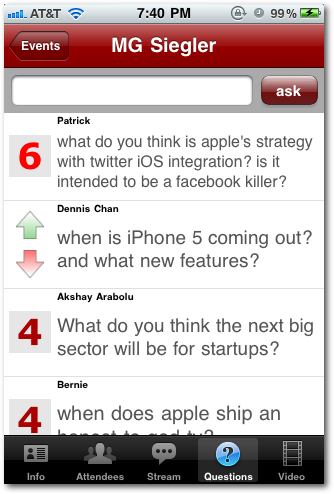
The Startup Grind.app version 1.2 has been approved and is live on the App Store! This update features some substantial re-design and refinement. The biggest change has been a complete re-design of the “Questions” pane. Now you can down-vote questions that you don’t like, redundant questions or non-questions. If a question gets to a value of -2 or lower (the equivalent of three negative votes and one positive vote) then the question will no longer be displayed. Remember, you can submit questions to the speaker far in advance of the actual event if you want.
Try it out and let us know what you think of the changes.
No Comments

As a partial follow up to my previous article “Play SNES Games On Your iPad Without Jailbreaking” I have now made a similar patch to the imame4all project which will allow it to build for non-jailbroken iOS devices. Everything appears to be in order except that I havn’t figured out a way to get the BTDaemon to run on a non-jailbroken device. This means that it can’t currently use Bluetooth controllers like the Wiimote. Digging into the btstack source it looks like you can configure it to talk with a BTDaemon process even if it is running on another machine like a Mac. I havn’t had time to fully investigate that yet though.
How To Get It Working Yourself
I have created a patch and script that will create everything for you automatically and set you up so that you can just build, run and go. Like the SNES-HD- patch before, you are going to need a current copy of Apple’s Developer Tools (tested with Xcode 3.2.6) and a copy of the iOS SDK (my changes assume the 4.3 SDK). You will need to be a paid iOS developer with Apple and have correctly configured your development machine and iOS device so that you can sign code and run said code on your device.
Read More →
9 Comments
The Startup Grind.app version 1.1 has been approved and is live on the App Store! There are some cool new features in this update! Try them out and let us know what you think.
Info Pane
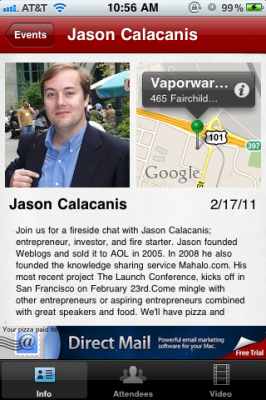
First, we have condensed a lot of information into a new “Info” pane:
- The complete details about the speaker and event.
- A map of where the event is being held (touch it to go look it up in the Maps application).
- A sponsor banner so you know who to thank for your free pizza that night (Wanna be a sponsor? Email Us).
This pane is the new hub of every event and is the pane that you now start in. |
 |
Read More →
No Comments
So you’re successful right? How successful? Let us count the ways. Let us count them by ranking you against your peers with an Elo ranked leaderboard and achievements. Remember that your worth can now be quantified and compared, so be sure to push your numbers as high as you can. “Greed, for lack of a better word, is good”. Welcome to the Wall Street update.
Complete Changelist:
- Bumped engineCompatibility to 0.5.10. (this means all games previously created by versions <= 0.5.9 will be deleted)
- Fixed a bug with the friction attachements that was casuing divergence.
- Taking another initial stab at redoing the cluster picker menu.
- Initial stab at 2X UI for the iPad.
- Added in-game stats panes and leaderboards.
- Designed the profile page and got initial replay functionality implemented.
- Made some changes to speed up app initialization.
- Added more capability to the stat gathering functionality.
- Added “Judge” capability.
- Added all the server-side support for interacting with judges and passing judgement on games.
- Added more stats functionality and judge bug fixes.
- Refined convex sweeping to only be super aggressive when dealing with the (thin) terrain.
- Fixed some concurrent loading bugs.
- Fixed a sound loading bug.
- Added a pragma to skip the intro.
I described the initial set of achievements that I had come up with in a previous blog post. For this update these are the achievements that are actually implemented and currently earnable:
| Boot Camp |
Rookie’s Luck |
Start A Fight With A Total Stranger |
Keep Your Enemies Close… |
| Finish Him |
Good Game |
Battle Hardened |
Angry Zurps |
| The General |
The Old College Try |
Flawless Victory |
LOL HAX |
| Peashooter |
Moonshot |
Greased Pig |
Heh Heh, Fire!, Fire!, Fire! |
| Rainbow Roll |
Lucky 7s |
Sky High |
Going The Distance |
| Pacifist |
One Hit Wonder |
Jack Of All Trades |
Critical Hit |
| Epic Fail |
McDuck |
The National Debt |
All Your Base |
Alpha Testing List
Would you like to be one of the awesome alpha testers that help make Cannonade great? Send an email to: [email protected] and I will reply with instructions on how to get onto the Trac server, Testflight list and tester forums.
No Comments

So my friend
Derek and I have this really cool event that we run called the
Startup Grind. It has been great to watch it blossom into a vibrant, well attended meetup over the past couple of months. The other day we sat down and talked about ways that we could add even more value to what we think is the best free startup event in silicon valley. One thing we wanted to try out was to see if there was some sort of technology solution that we could come up with to make the networking at our event even easier and more valuable. Thus the concept of the Startup Grind app was born. First concept to App Store submission was exactly three weeks to the day. Now that you can get it in your hands, let me give you a tour of it’s main features.
Read More →
No Comments
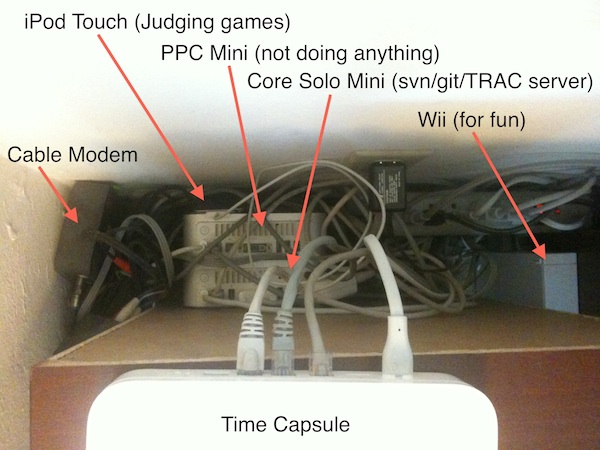
Top-down view of the Aoren Software datacenter in the living room corner.
Why, you might ask? In my case the answer is simply because it is my only alternative. In development of my game Cannonade there quickly arose a need to be able to replay my user’s completed games and validate the results with exactness. In order to obtain that level of exactness, my games must execute with complete determinism. Unfortunately the implementation of floating-point match according to IEEE754 can actually vary somewhat between x86 and ARM processors. This means that if I replayed a game that two of my users played using iOS devices on an x86-based server, the results of the replay would very quickly diverge. Thus I am left with no choice but to set up a dedicated iOS device to wait for notifications of the matches that it needs to replay and validate (a process I call judging). An iOS server you might say.
Read More →
2 Comments
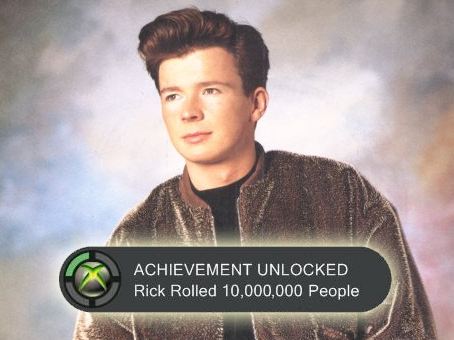
One crucial aspect of my game that I have been thinking of for a while has been that of in-game achievements. There is just something about the hormones that get secreted in your brain the first time that sound or notification goes off that hooks you like the first line. I have come up with an initial set of 40 achievements that I will hopefully have implemented by the next seed. Your challenge: tell me what you think in the comments below, let me know of any cool ideas you have for achievements and bonus points for anyone that can name all the movie, video game or cultural references below.
Read More →
No Comments
Did you know that bullets (and other quick moving objects) in video games sometimes exhibit magical properties if they move too fast? If they gain enough speed, sometimes they can even pass completely through other objects without leaving a scratch or affecting them at all! You might have seen this happen occasionally in games that have a lot of complicated physics simulation. Sometimes fast moving objects just seem to pass through the ground or other objects. Unfortunately this is not a desirable user experience and it quickly breaks the illusion the game is trying to convey. This phenomenon is called “tunneling” and game developers attempt to deal with it in a variety of different ways. I thought I would share my unique combination of techniques to deal with it that I used in Cannonade. I have not seen this specific combination of techniques explained or suggested anywhere and so I thought it might be beneficial to share what I have learned with others who might also be suffering from object tunneling woes. First lets explain how most modern game physics simulation works and investigate why this problem crops up.
Read More →
3 Comments

Apple gets a lot of flack over its curated app distribution model. No matter what your opinion on the subject is there is no doubt that for Apple’s model to have any sort of success it needs to be the only commercially realistic distribution avenue on the platform. This leads many people to jailbreak their devices for a variety of different reasons. Lets examine just the motivation of wanting to personally use non-App Store approved apps. The argument is then almost always framed as a dichotomy. I can jailbreak and get access to apps that Apple cannot or will not approve but risk damaging the device, violating warranty/support expectation, losing the ability to directly update to the latest OS version and introducing instability. Or I could keep my device in a stock configuration that will ensure stability and a clean upgrade path but miss out on some truly awesome and useful jailbroken apps out there. People don’t often remember that there is actually a third way to load apps onto your iOS device that has its own set of unique pros and cons. Apple fully supports loading apps on stock devices outside of the App Store through its developer program.
Read More →
17 Comments
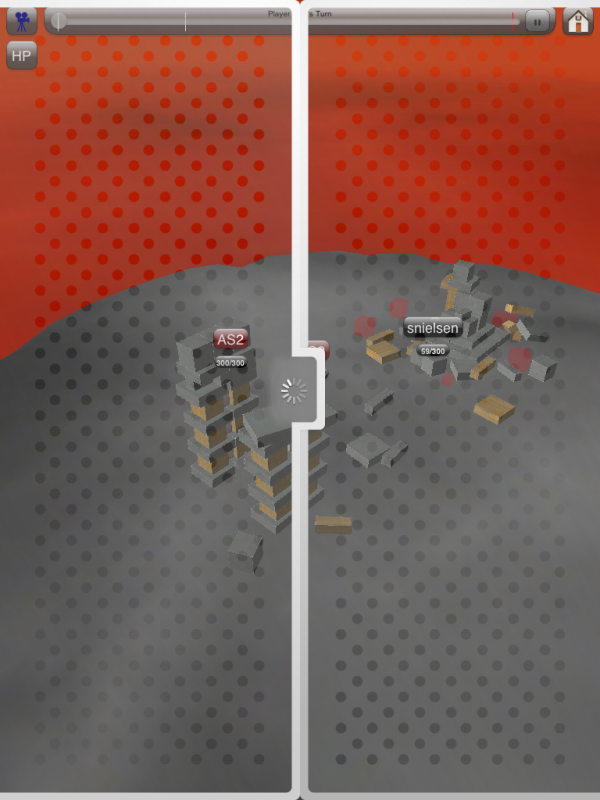
I have decided to give names to all of my alpha updates going forward. I have chosen to follow a movie theme naming convention. I am therefore proud to announce the “Primer” update (Cannonade 0.5.9). Aptly named, this update finally adds the timeline scrubbing feature! This feature allows you to pause and restart the game at any point in the past by dragging the timeline slider and hitting the play button. Perforated glass doors quickly shut and you hear the low hum of time travel occurring in the background. Once the universe has temporally moved to your desired point the doors open and you can watch history repeat itself!
Complete Changelist:
- Bumped engineCompatibility to 0.5.9. (this means all games previously created by versions <= 0.5.8 will be deleted)
- Got the timeline scrubbing working!
- Added a neat glass door progress indicator when you jump through time.
- Moved auto-camera to only be active during opponent’s turns.
- Did a top to bottom redesign of the cluster menu
- Added basic OpenGL lighting to blocks.
- Added an initial pass of the intro sequence.
- Moved the castle picking view to one-quarter height up.
- Used glPolygonOffest to correct decal the friction splatter.
- Changed the editor so that it moves the camera to the half-height everytime the blocks change.
- Baked the current levels and fixed some bugs related to baking.
- Added history grabbing functionality.
- Fixed a lot of bugs related to observing various points in the timeline.
- Modified the project so that I could submit a dummy IPA to iTunes Connect so I can keep my identifier (I hope).
- Made a new Pad+Phone based experience.plist.
- Changed the level’s info format from a serliazed file to an NSDictionary/plist.
- TONS of changes aimed at making it easy to integrate art.
- Removed the individual block textures now that the atlas is working everywhere.
- Pulling demo/intro values into the experience.plist.
- Initial demo intro game type implementation.
- Added a dummy account loging pragma (LOGINASAORENTEST1).
- Minor tweaks.
Alpha Testing List
Would you like to be one of the awesome alpha testers that help make Cannonade great? Send an email to: [email protected] and I will reply with instructions on how to get onto the Trac server, Testflight list and tester forums.
2 Comments



 Spencer Nielsen